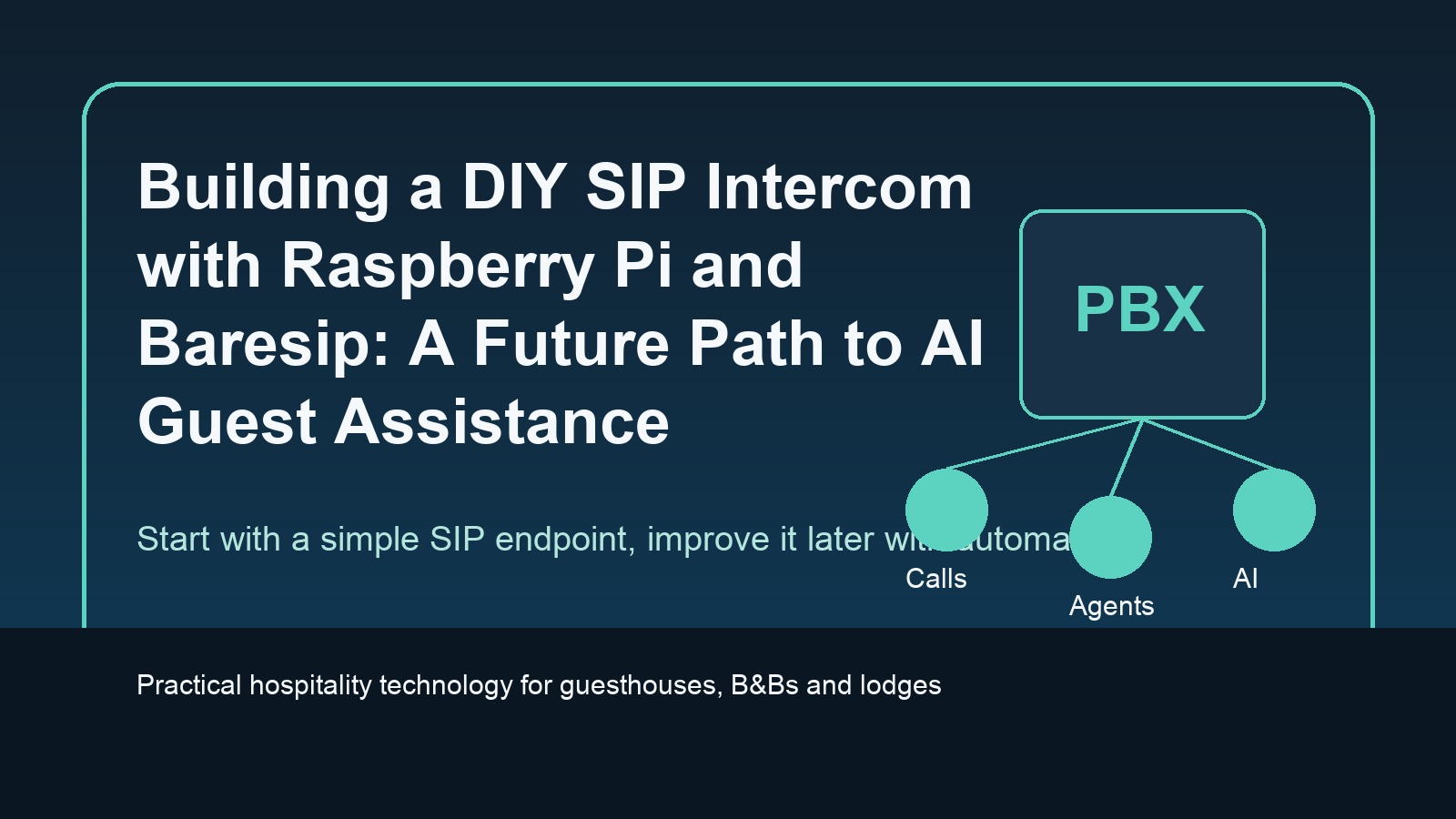
Once a property starts thinking of the PBX as a communication platform, another idea becomes interesting: could some simple intercom endpoints be built in-house? For a technically minded owner or developer, a Raspberry Pi running SIP software such as Baresip can become a useful experiment.
This does not mean every guesthouse should replace commercial intercoms with hobby electronics. A main gate, emergency point or guest-facing device needs reliability and support. But for testing, staff areas, proof-of-concepts and future AI-assisted workflows, a DIY SIP endpoint can teach a lot.
Key takeaways
- A Raspberry Pi can act as a SIP endpoint when paired with audio hardware and software such as Baresip.
- The first goal should be a reliable simple intercom, not an AI bot.
- DIY endpoints are useful for experiments, staff areas and prototypes.
- Once SIP audio is stable, later improvements can include automation, speech recognition and controlled AI responses.
What Baresip does
Baresip is a lightweight SIP user agent. In plain language, it can register to a PBX like a phone extension and make or receive SIP calls. On a Raspberry Pi, it can be paired with a speaker, microphone, button, USB audio adapter or small amplifier depending on the use case.
The PBX sees it like another extension. That means the device could call reception, auto-answer a trusted internal call, play a message, or become part of a simple staff communication flow.
A practical DIY intercom path
- Start with the PBX: create a dedicated SIP extension for the Raspberry Pi.
- Install and configure Baresip on the Pi.
- Connect known working audio hardware before building a case or button.
- Test one-way and two-way audio on the local network.
- Add a simple call button or script to dial reception.
- Restrict the extension so it can only call approved numbers.
- Document the setup and decide whether it is only for testing or suitable for controlled internal use.
Possible hospitality use cases
- A staff-area call point from laundry or maintenance to reception.
- A prototype guest information endpoint in a common area.
- A back-office announcement speaker with controlled auto-answer.
- A test device for future voice workflows before buying commercial hardware.
- A developer sandbox for learning how SIP, audio and automation fit together.
The AI bot idea: useful, but not first
It is tempting to jump straight to an AI guest assistant. In theory, a SIP endpoint could later connect to speech-to-text, a rules engine, property knowledge, text-to-speech and escalation logic. It could answer simple questions such as breakfast times, Wi-Fi details or check-out instructions.
But the safe order is important. First make the endpoint reliable. Then add logging and permissions. Then add a limited script. Only after that should AI be introduced, and even then with strong boundaries: no payment handling, no sensitive personal information, and a clear route to a human when the question is important.
Common mistakes
- Using DIY hardware for a critical guest or security function too soon.
- Exposing SIP services directly to the internet.
- Ignoring echo, microphone placement and speaker feedback.
- Building an AI assistant before the basic call path is stable.
- Forgetting power, enclosure, cooling and maintenance realities.
Frequently asked questions
Can a Raspberry Pi become a SIP intercom?
Yes. With Baresip, suitable audio hardware and a PBX extension, a Raspberry Pi can work as a basic SIP endpoint for experiments or controlled use.
Is a DIY intercom suitable for a main gate?
Usually not as a first step. A production gate needs reliability, weather protection, access control integration and support. DIY is better for learning, prototyping and internal call points.
Can this become an AI bot later?
Potentially. Once the SIP audio path is stable, it can be connected to automation and AI services, but the design should include privacy, fallback and human escalation from the start.
Final thought
A Raspberry Pi SIP intercom is a good example of how small experiments can lead to future hospitality automation. Start with something simple and useful, learn from it, and only then add intelligence where it genuinely reduces friction for guests and staff.