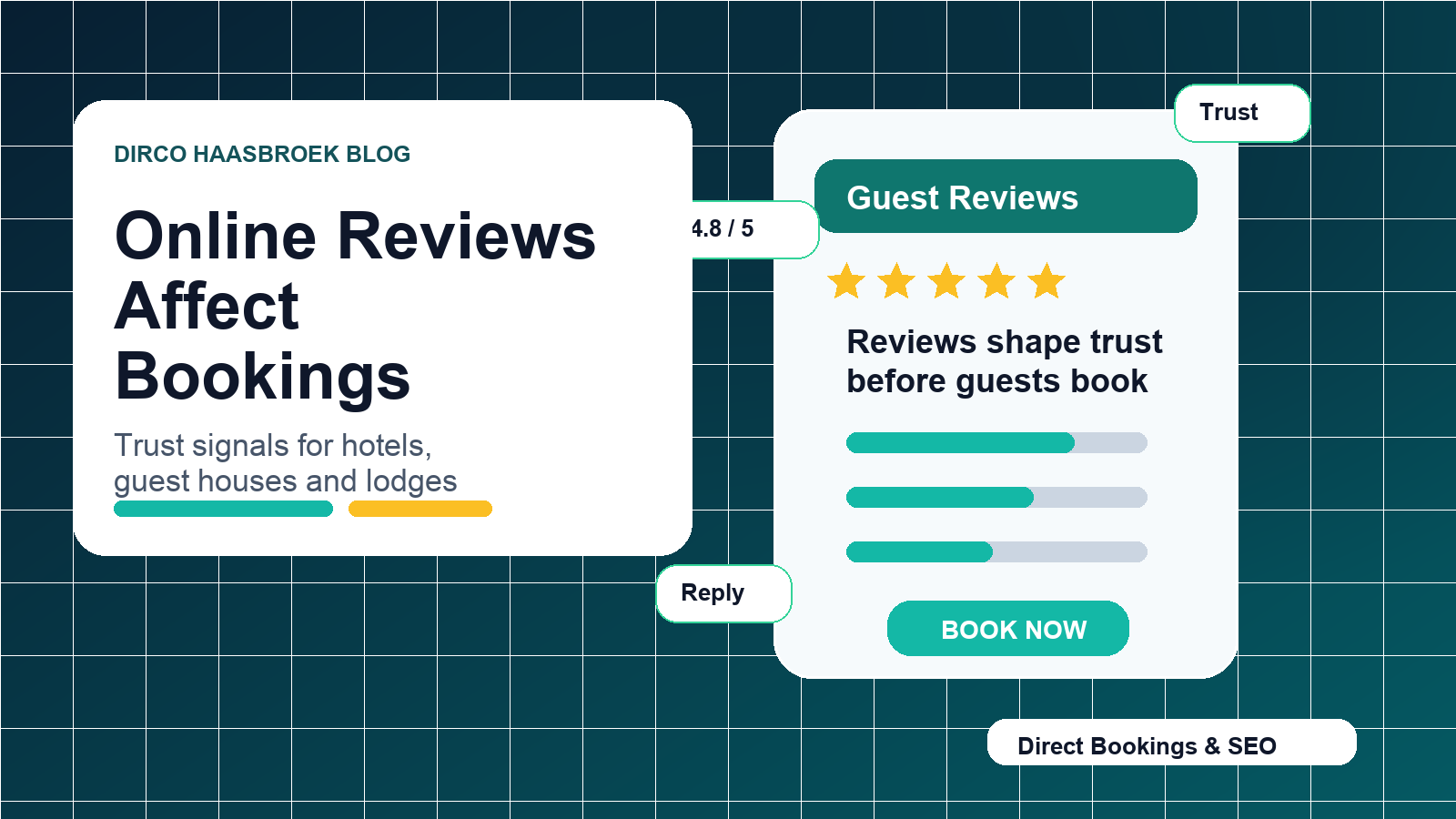
Online reviews have become one of the most important trust signals in accommodation. Before a guest phones, sends a WhatsApp, checks availability or clicks a booking engine, they usually want to know one simple thing: can I trust this place?
For hotels, guest houses, lodges, B&Bs and self-catering properties, reviews do more than make a business look popular. They affect how confident people feel, how your property appears in search, how much comparison shopping guests do, and whether someone books directly or goes back to an OTA.
Key takeaways
- Online reviews influence bookings because they reduce uncertainty before a guest commits.
- Recent, specific reviews are often more persuasive than a perfect score with little context.
- Reviews support both direct bookings and local SEO, especially when guests mention location, service and facilities.
- How you reply to reviews can build trust almost as much as the reviews themselves.
- A simple review management process is better than only asking for reviews when bookings are quiet.
Why reviews matter before the booking happens
Accommodation is a personal decision. Guests are not only buying a bed for the night; they are choosing a place where they will sleep, park, arrive late, meet family, attend a wedding, visit a hospital, work remotely or take a short break. That makes trust more important than it is in many other online purchases.
A good review gives a potential guest a shortcut. Instead of relying only on your own description, they can see what previous guests experienced. That third-party confirmation helps answer the questions that often sit behind a booking decision: Was it clean? Was the host responsive? Was the location convenient? Did the photos match the real experience?
The main ways online reviews affect bookings
1. Reviews increase booking confidence
A property with clear, recent reviews feels less risky. This is especially important for smaller guest houses and independent accommodation businesses that may not have the brand recognition of a large hotel group. Reviews act like social proof: other people have stayed here, and their experience was good enough to mention publicly.
2. Reviews help guests choose between similar properties
In many destinations, guests compare several properties with similar prices, photos and facilities. The review profile can become the deciding factor. A property with helpful comments about friendly staff, fast replies, safe parking, reliable Wi-Fi or good breakfast can stand out even when the room rate is not the cheapest.
3. Reviews support local SEO and visibility
Reviews can also help search visibility. When guests mention your town, nearby landmarks, room types, service quality or facilities, those details add useful context around your business. This does not replace proper hotel website SEO, but it supports the broader picture of relevance and trust.
4. Reviews reduce dependence on OTAs
Many guests discover accommodation through OTAs, but reviews can help move more confidence back to your own brand. If your Google Business Profile, website testimonials and direct booking pages make guests feel secure, they are more likely to book with you directly instead of returning to a third-party platform. This connects directly to why direct bookings matter for hotels and guest houses.
What guests look for in reviews
Guests do not only look at the star rating. They look for patterns. A few practical details can matter more than a generic five-star comment. For accommodation businesses, the most useful reviews often mention:
- cleanliness and maintenance
- staff friendliness and response time
- location and nearby attractions or businesses
- parking, safety and arrival process
- Wi-Fi quality, workspace or business-travel convenience
- whether the photos and description matched reality
This is why it helps to ask guests for honest, specific reviews rather than only saying “please rate us”. Specific reviews give future guests practical decision-making information.
Common review mistakes accommodation owners make
- Only responding to negative reviews. Thanking happy guests shows that the business is active and attentive.
- Using defensive replies. Even if the guest is unfair, future guests are watching how you handle pressure.
- Ignoring old review profiles. A good score from years ago is less convincing than recent feedback.
- Hiding reviews away from the direct booking journey. If your website asks people to book directly, it should also help them trust that decision.
- Not asking consistently. Reviews should be part of the checkout or post-stay process, not an occasional panic task.
How to use reviews to improve direct bookings
Start by making reviews visible where guests make decisions. Your website can include selected testimonials, links to your Google reviews, and trust signals near key enquiry or booking sections. If you use a booking engine, reviews should support the journey rather than distract from it. This pairs well with choosing the best booking engine for guest houses and small hotels.
Next, build a simple reply process. A short, human response is usually enough: thank the guest, mention one detail from their stay, and invite them back. For negative reviews, acknowledge the issue, avoid arguments, and explain what you are doing to improve. The goal is not to win a public debate; it is to show future guests that your business is responsible.
Finally, connect reviews to your guest communication workflow. A polite post-stay WhatsApp or email can ask for feedback while the stay is still fresh. If you already use reply templates, this fits naturally with improving guest communication and reducing manual back-and-forth.
A practical review checklist
- Check Google, OTA and social review platforms weekly.
- Reply to both positive and negative reviews in a calm, human tone.
- Ask happy guests for specific feedback after checkout.
- Add selected reviews or trust signals to your direct booking pages.
- Look for repeated complaints and fix the operational issue behind them.
- Track whether review improvements line up with more direct enquiries or better conversion rates.
Frequently asked questions
Do online reviews really affect hotel bookings?
Yes. Reviews affect bookings because they help guests judge trust, cleanliness, service and overall value before they commit. They are especially important for independent hotels and guest houses where brand recognition may be lower.
Is a perfect five-star rating necessary?
No. A strong, realistic rating with recent and detailed reviews is usually more believable than a perfect score with very few comments. Guests often look for patterns and how the business responds.
Should accommodation owners reply to every review?
It is a good practice to reply to as many reviews as possible, especially recent reviews and any review that raises a concern. Replies show future guests that the property is active, attentive and willing to improve.
Related reading
- Why Direct Bookings Matter for Hotels and Guest Houses
- Best Booking Engine for Guest Houses and Small Hotels
- Hotel Website SEO Guide for Guest Houses and Accommodation Owners
- Backlinks Explained for Guesthouses
Online reviews are not just a reputation box to tick. They are part of the booking journey. When reviews, website content, communication and direct booking tools all work together, technology does what it should do: it makes the guest’s decision easier.