

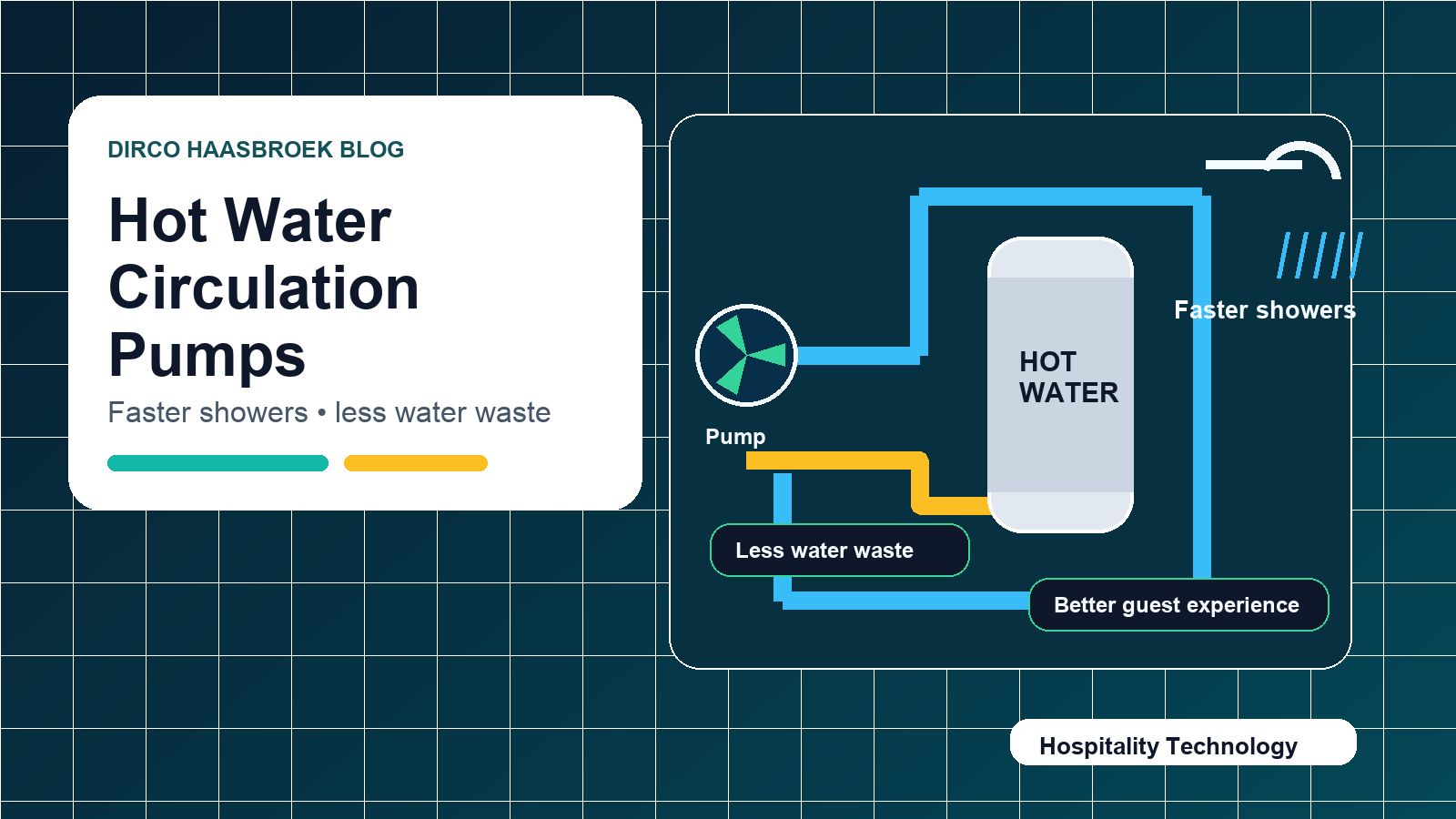
One of the small frustrations guests rarely mention in a review, but definitely notice, is standing in a shower waiting for hot water to arrive.
For a hotel, guest house, lodge, or self-catering property, slow hot water is more than a plumbing inconvenience. It affects guest comfort, wastes water, increases housekeeping complaints, and can quietly damage the feeling of quality you are trying to create.
A hot water circulation pump, also called a hot water recirculation pump, can solve much of this problem when it is designed and controlled properly.
Key takeaways
- A hot water circulation pump helps move hot water closer to taps and showers before the guest opens them.
- For hotels and guest houses, the main benefit is better guest experience and less water wasted while waiting.
- The system must be designed carefully, otherwise it can waste energy by keeping pipes hot all day.
- Smart controls can use timers, occupancy, motion sensors, temperature sensors, or pressure changes to run the pump only when needed.
- Installation should be handled by a qualified plumber and electrician, especially where mains power, geysers, pressure systems, and guest safety are involved.
What is a hot water circulation pump?
A hot water circulation pump is a small pump installed on a hot water system to circulate hot water through the pipework. The goal is to reduce the delay between opening a tap and receiving hot water.
In a simple plumbing setup, hot water sits in the geyser or hot water cylinder. When someone opens a tap far away from the geyser, the cold water already sitting inside the pipe must first run out before hot water arrives. That is why some bathrooms take a long time to get hot water.
A circulation system keeps hot water moving through a loop, or brings it closer to the point of use, so the wait is much shorter.
Why this matters in hotels and guest houses
In a private home, waiting 30 to 60 seconds for hot water is irritating. In hospitality, it can feel like poor service.
Guests expect the basics to work without thinking about them: clean rooms, good Wi-Fi, comfortable beds, secure parking, and reliable hot showers. When hot water is slow, guests may not always complain, but it creates friction at exactly the wrong moment — early morning, late evening, or before checkout.
- Better guest comfort: hot water arrives faster at showers and basins.
- Less wasted water: less cold water is sent down the drain while the guest waits.
- Fewer complaints: slow hot water is one of those operational issues guests remember.
- More consistent service: useful for properties with rooms far from the main geyser or plant room.
- Stronger perceived quality: instant or near-instant hot water feels professional.
The important trade-off: water saving vs energy use
A circulation pump can save water, but it can also waste electricity if it runs all day or keeps long pipe runs hot unnecessarily.
This is where many installations go wrong. A pump that runs continuously may reduce waiting time, but it can increase heat loss from the pipes and add unnecessary pump runtime. For hotels, the better approach is usually controlled circulation: run the pump when hot water is likely to be needed, then stop it once the pipe is warm enough.
In other words, the goal is not simply “install a pump”. The goal is to design a system that improves guest comfort without creating a new energy problem.
Smart control options for hotel hot water circulation
The most useful idea from the shared controller concept is that the pump does not have to run blindly. It can respond to real conditions.
1. Timer-based control
This is the simplest method. The pump runs during peak demand periods, such as early morning, evening, and common checkout times.
It is easy to understand and maintain, but it is not always efficient if occupancy changes often.
2. Temperature-based control
A temperature sensor on the hot water return or pipe can tell the controller when the line is warm enough. For example, the pump can stop when the pipe reaches a set temperature and only restart after the pipe cools down again.
This avoids unnecessary runtime and protects the pump from running longer than needed.
3. Motion or occupancy-based control
For some bathrooms or shared facilities, a motion sensor can trigger the pump before the guest opens the tap. The system detects movement, checks whether the pipe is cool, then runs the pump for a short period.
This can work well in controlled areas, but it must be designed carefully to avoid false triggers and privacy concerns.
4. Pressure or flow-based control
A pressure switch or flow sensor can detect when water is opened. The pump then starts automatically and stops once the hot water line reaches the target temperature or after a maximum runtime.
This is closer to a demand-based system and can be useful where motion sensing is not practical.
A practical control logic example
A smart hotel-friendly setup could follow this basic logic:
If motion is detected OR water pressure changes:
    Check the hot water pipe temperature
    If the pipe is cooler than the target temperature:
        Turn the circulation pump on

While the pump is running:
    Stop when the pipe reaches the target temperature
    Or stop after a maximum safe runtime

After stopping:
    Wait for a minimum rest period before starting again
In the prototype-style thread, this was done with an ESP8266 relay board, PIR motion sensors, a pressure switch, and a DS18B20 waterproof temperature sensor. For a hotel installation, the same thinking is useful, but the final system should be built with proper electrical protection, plumbing standards, and reliable commercial-grade components.
Suggested starting settings
Every property is different, but a starting point for a controlled circulation system might be:
- Pump start condition: motion, timer, pressure, or flow event.
- Pump off temperature: around 40°C at the monitored pipe point.
- Restart temperature: only restart after the monitored pipe cools to around 35°C.
- Maximum runtime: around 2–3 minutes, depending on pipe length and pump size.
- Minimum off time: a short rest period to avoid rapid cycling.
These are not universal design values. They should be adjusted by a qualified installer based on pipe length, geyser temperature, insulation, pump specification, number of rooms, and local safety requirements.
Where hotels should be careful
- Legionella and water safety: hot water systems must be managed safely. Do not reduce storage temperatures or circulation temperatures without professional advice.
- Pipe insulation: uninsulated hot water loops lose heat quickly and can increase electricity costs.
- Electrical safety: pumps, relays, controllers, and sensors must be installed in safe enclosures with correct protection.
- Pump sizing: the wrong pump can be noisy, inefficient, or ineffective.
- Maintenance access: make sure filters, valves, sensors, and pumps can be serviced later.
- Guest disruption: plan installation around occupancy and room availability.
Is it worth it for a small hotel or guest house?
It can be, especially if guests wait a long time for hot water in certain rooms. The strongest candidates are properties with long pipe runs, rooms far from the geyser, multiple bathrooms on one hot water system, or repeated comments about slow hot water.
Before installing anything, measure the current problem:
- How long does hot water take to reach each room?
- How much water runs before it becomes warm?
- Which rooms are worst affected?
- Are pipes insulated?
- Is the hot water system centralised or room-based?
- When is the demand highest?
That small audit will help you decide whether you need a circulation pump, better pipe insulation, a different geyser layout, point-of-use water heaters, or a smarter control system.
A simple hotel checklist before installing
- Map the hot water pipe runs and identify the slowest rooms.
- Measure hot water waiting time at different times of day.
- Check pipe insulation and heat loss.
- Ask a plumber whether a return loop already exists or can be added.
- Choose a pump designed for hot water circulation.
- Decide on the control method: timer, temperature, pressure, occupancy, or a combination.
- Include a maximum runtime and safety cutoff.
- Use a qualified electrician for mains wiring.
- Document the installation for future maintenance staff.
Final thought
A hot water circulation pump is not the most glamorous hospitality upgrade, but it is exactly the kind of operational improvement guests feel immediately.
The best installations are not just about faster hot water. They balance comfort, water saving, energy use, safety, and maintainability. For hotels and guest houses, that is where practical technology makes a real difference: it removes friction from the guest experience without making the guest think about the technology at all.
Related reading
- Hotel Website SEO Guide for Guest Houses and Accommodation Owners
- The 5 WhatsApp Replies That Reduce Back-and-Forth
- What Is the llms.txt File, and How Do You Create One for Your Website?
FAQ
Does a hot water circulation pump save money?
It can save water and improve comfort, but it may increase electricity use if it runs too often. The best results usually come from controlled circulation, pipe insulation, and correct pump sizing.
Should a hotel run a circulation pump all day?
Usually not unless the system was specifically designed for that. Continuous circulation can increase heat loss. Timers, temperature sensors, and demand-based controls are often better.
Can motion sensors be used to start a hot water circulation pump?
Yes, in some situations. A motion sensor can trigger the pump when someone enters a bathroom or shared facility, but the setup must avoid false triggers and should include temperature and runtime limits.
Who should install a hotel hot water circulation pump?
A qualified plumber should handle the hot water system design and pipework, and a qualified electrician should handle mains wiring and electrical protection.