

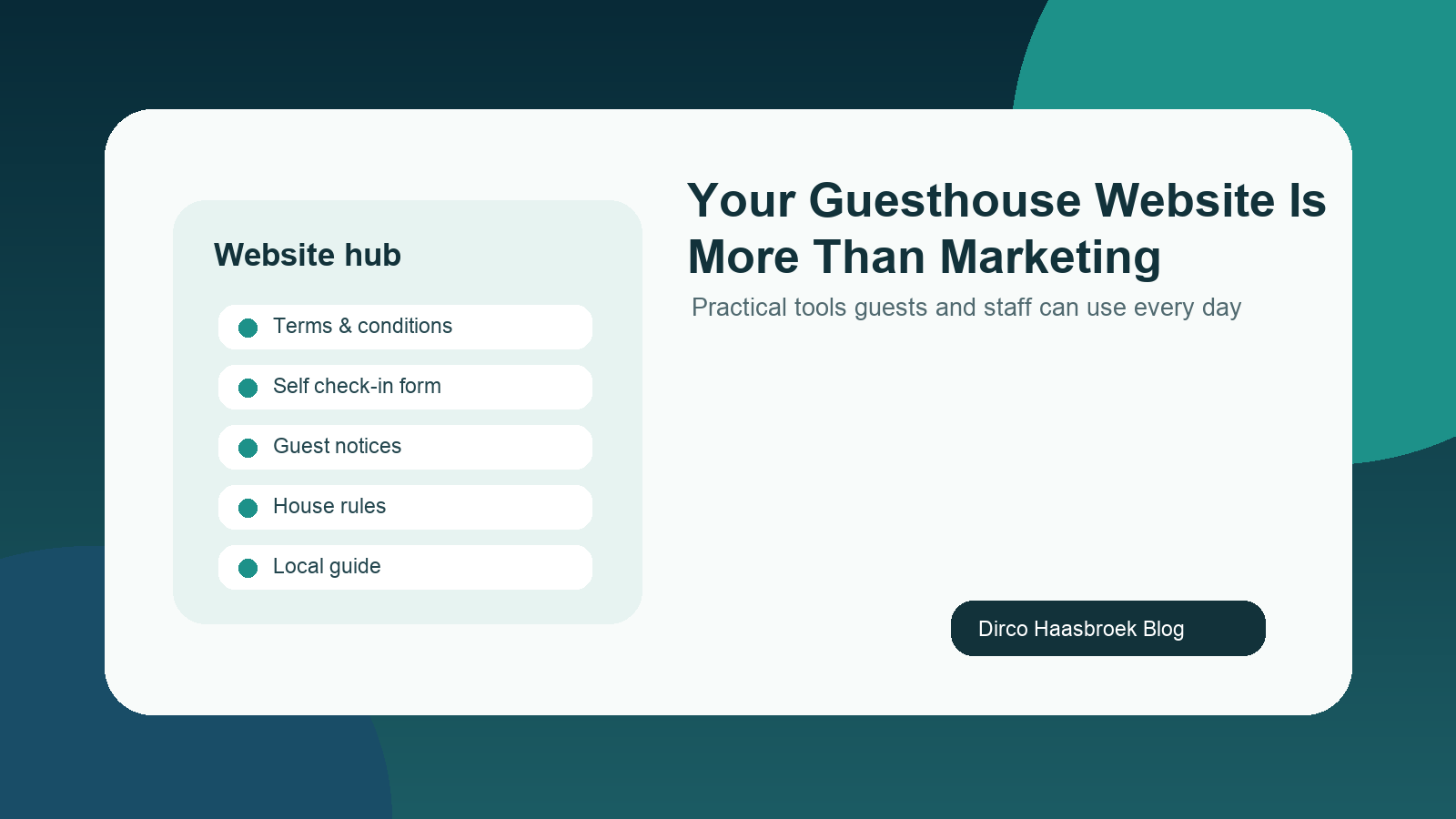
Most accommodation owners think of their website as a marketing tool. That is understandable. A good website should help guests find the property, understand the rooms, trust the business and make a booking.
But a guesthouse website can be much more than an online brochure. Used properly, it can become a practical operational hub for guests, staff and repeat communication.
This is especially important for guest houses, lodges, B&Bs and self-catering properties where the same information is often repeated across emails, WhatsApp messages, booking confirmations and phone calls.
Key takeaways
- A guesthouse website should support both marketing and daily operations.
- Practical pages can reduce repeated questions from guests.
- Terms, notices, check-in instructions and house rules are easier to manage when they live in one central place.
- Website links can be reused in email footers, WhatsApp replies and booking confirmations.
- Simple forms and guest tools can improve the guest experience before arrival.
A website should not only attract guests
Marketing is only one part of the job. Yes, the website should show your rooms, location, rates, amenities and reasons to book direct. But after the guest has booked, the website can still keep working.
It can answer questions, collect information, explain policies, guide arrivals and give guests a reliable place to find updated details.
1. Terms and conditions in one central place
Instead of attaching PDF documents to every email or rewriting policy details manually, a guesthouse can keep its terms and conditions on a dedicated website page.
This page can include cancellation rules, payment terms, check-in and checkout times, refund conditions, pet policies, smoking rules, breakage deposits, noise policies and visitor rules.
The benefit is consistency. If a policy changes, you update one page and link to it everywhere.
2. Important notices linked from your email footer
Many properties need to communicate practical notices: water interruptions, power backup information, roadworks, gate access, seasonal restaurant closures, pool maintenance or special arrival instructions.
Instead of sending long explanations every time, the website can host an “Important Guest Notices” page. That link can be added to email footers, booking confirmations and WhatsApp templates.
This gives guests one current place to check before arrival.
3. Self check-in forms
A self check-in form can collect useful details before the guest arrives. This may include ID or passport details where legally required, arrival time, vehicle registration, contact number, special requests and agreement to house rules.
This is not only convenient for the property. It also improves the guest experience because arrival can feel more organised and less rushed.
4. Digital house rules and guest information
House rules do not need to be hidden in a printed file in the room. A website page can explain Wi-Fi details, parking rules, quiet hours, breakfast times, pool rules, emergency contacts, load-shedding information and appliance instructions.
A QR code in the room can link directly to this guest information page. That means guests can find answers without calling reception for every small question.
5. Local recommendations and area guides
Guests often ask the same local questions: where to eat, what to do nearby, which routes are safest, where to buy groceries or which attractions are worth visiting.
A simple local guide page can improve the stay and support local businesses. It can also help your website rank for useful local searches over time.
6. Booking-related forms
Beyond a basic enquiry form, a hospitality website can include practical forms such as late arrival requests, airport transfer enquiries, breakfast preference forms, special occasion requests, pet approval forms or long-stay enquiry forms.
These forms help structure information so staff do not have to piece together details from scattered messages.
7. Repeat guest and direct booking links
A website can also support repeat bookings. Past guests can be sent a direct booking link, return-stay offer or seasonal package page instead of being sent back to an OTA.
This keeps the guest relationship closer to the property and helps reduce commission dependency over time.
8. Staff and operations resources
Some website pages do not even need to be public. A private or hidden page can hold staff checklists, supplier contact details, emergency procedures, cleaning standards or maintenance reporting forms.
For small accommodation businesses, this can be a simple way to keep operational information organised without introducing a complicated system too early.
Common mistakes accommodation websites make
- Treating the website as a once-off brochure instead of a living business tool.
- Keeping policies in old PDFs that are difficult to update.
- Sending long repeated messages instead of linking to clear pages.
- Not having a mobile-friendly guest information section.
- Using forms that collect too little information to be useful.
- Forgetting to connect website pages with email footers, WhatsApp templates and booking confirmations.
The operational value of a better website
A practical hospitality website reduces friction. Guests get clearer information. Staff answer fewer repeated questions. Policies are easier to manage. Arrival feels smoother. The property looks more organised.
That is the real value. The website supports the guest journey before, during and after the stay.
Related reading
- Why a Website Is Important for Accommodation Providers
- Direct Bookings: Better Guest Relationships, Lower Commissions and Better Stays
- Best Booking Engine for Guest Houses and Small Hotels
- Google Business Profile for Guest Houses
Need practical functionality on your hospitality website?
If your guesthouse, lodge, B&B or self-catering business needs more than a basic brochure website, Dirco Haasbroek is a freelance web developer who specialises in hospitality websites and practical website functionality for accommodation businesses.
Whether you need better enquiry forms, self check-in flows, guest information pages, direct booking CTAs, terms pages or operational website tools, you can start here: https://dircohaasbroek.com.
Frequently asked questions
What else can a guesthouse website be used for besides marketing?
A guesthouse website can host terms and conditions, guest notices, self check-in forms, house rules, local guides, FAQs, payment instructions, emergency contacts and operational forms.
Should guesthouses link website pages from email footers?
Yes. Linking important pages such as terms, check-in instructions and guest notices from an email footer gives guests a consistent place to find current information.
Can a website help reduce admin for accommodation owners?
Yes. Practical website features such as forms, FAQs, notice pages and automated instructions can reduce repetitive questions and make communication more consistent.
Final thought
A guesthouse website should help people find you, but it should also help people stay with you. The more practical and useful your website becomes, the more it supports your team, your guests and your direct booking strategy.