

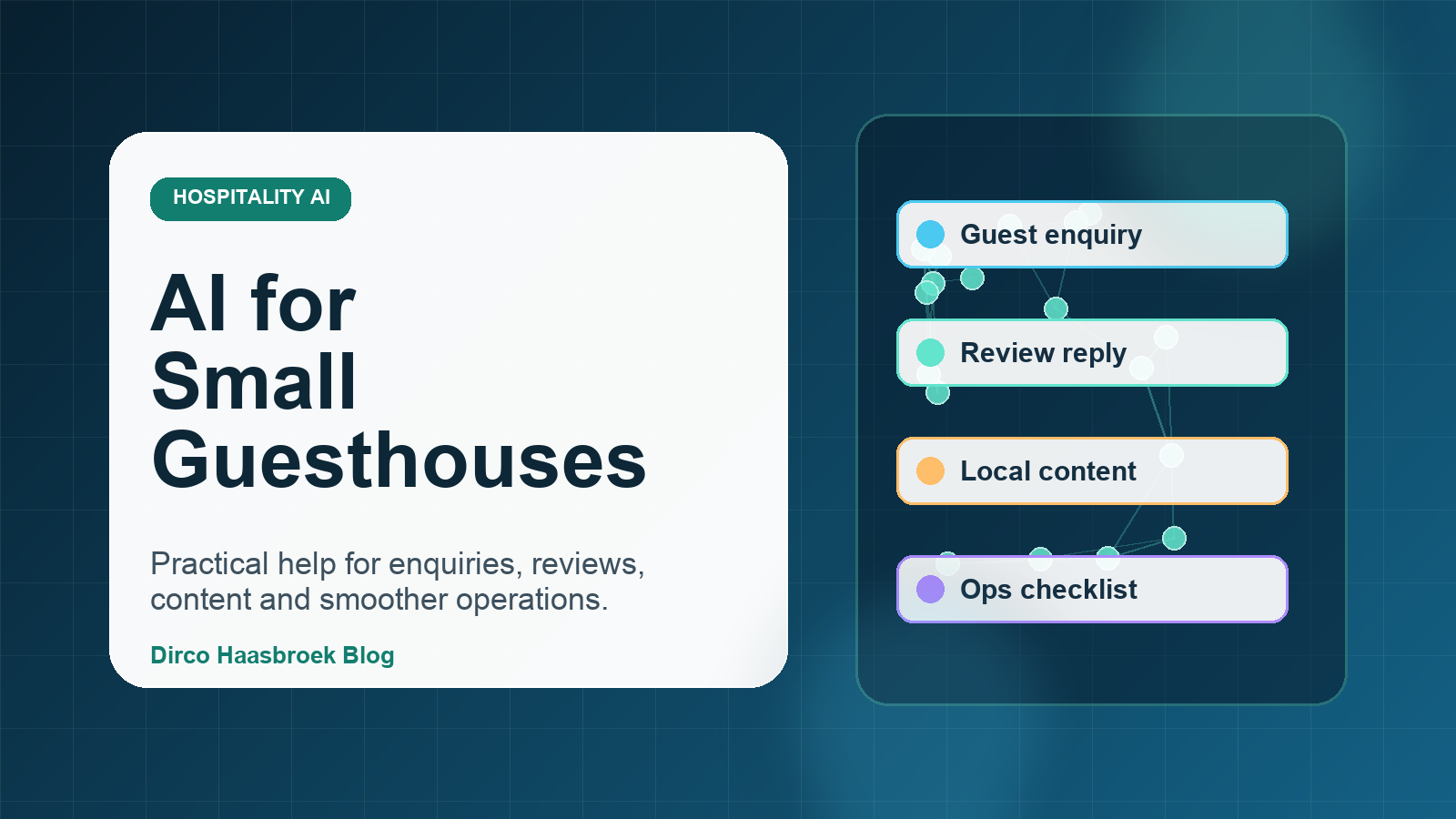
Artificial intelligence often sounds like something built for large hotel groups with big budgets, complex systems, and dedicated technology teams. But that is not the full story. Some of the most useful AI opportunities are actually very practical for small guesthouses, B&Bs, lodges, and self-catering properties.
For a small accommodation business, the value of AI is not about replacing hospitality. It is about reducing the repetitive work that takes owners and managers away from guests, maintenance, marketing, and decision-making. Travel will always be a personal choice; technology should simply make that choice easier for the guest and easier to manage for the property.
Key takeaways
- AI can help small guesthouses respond faster without losing their personal tone.
- It can assist with guest enquiries, review replies, content ideas, translations, and simple operations.
- The best use of AI starts with small, low-risk tasks before moving into deeper automation.
- AI works best when it supports the owner or team, not when it pretends to replace them.
Why small guesthouses should pay attention to AI
Small guesthouses often operate with limited staff. The same person may answer WhatsApp enquiries, update rates, check bookings, welcome guests, handle complaints, post on social media, respond to reviews, and still keep an eye on the property itself.
That workload creates a simple problem: important tasks get delayed because urgent tasks keep interrupting the day. A guest enquiry comes in while someone is doing a check-in. A review needs a thoughtful response, but there are rooms to inspect. The website needs fresh content, but there is no quiet time to write.
This is where AI can become useful. It can act like a support assistant that helps prepare answers, organise information, draft content, and identify patterns. The owner still makes the decision, but the blank page and repetitive typing are reduced.
1. Faster replies to guest enquiries
One of the most immediate uses of AI is helping with guest communication. Small properties receive many similar questions: check-in times, parking, breakfast, pet policies, distance to attractions, cancellation rules, and whether a room is suitable for a family.
AI can help draft reply templates that sound natural and helpful. Instead of copying the same answer repeatedly, a guesthouse can build a small library of approved responses and adapt them quickly for each guest. This can be especially useful for WhatsApp, email, website enquiry forms, and social media messages.
The important point is that the reply should still feel human. AI can prepare the first draft, but the guesthouse should check the details before sending, especially when rates, availability, policies, or special requests are involved.
2. Better review responses
Online reviews influence booking decisions. Yet many small properties either do not respond to reviews or respond only when there is a complaint. AI can help draft polite, specific, and professional replies to both positive and negative reviews.
For positive reviews, AI can help avoid generic replies like “Thank you for your feedback.” For negative reviews, it can help make the tone calm and constructive, which is often difficult when the owner feels personally attacked.
A good review response does not need to be long. It should acknowledge the guest, mention something specific where possible, and show future travellers that the property pays attention.
3. Content ideas for direct bookings
Many guesthouse websites have only the basic pages: rooms, rates, contact details, and a gallery. That is important, but it often does not answer the real questions guests search for before booking.
AI can help generate content ideas around local travel intent, such as “where to stay near [attraction],” “best weekend accommodation in [area],” “family-friendly guesthouses near [destination],” or “what to do in [town] over a long weekend.” These topics can support direct bookings by making the website more useful and visible.
The guesthouse still needs local knowledge. AI may suggest the structure, but the owner should add real details: nearby restaurants, travel times, parking tips, seasonal advice, and the kind of guest the property suits best.
4. Simple translations and clearer wording
Small accommodation businesses often welcome guests from different countries. AI can assist with basic translations, rewriting house rules in clearer language, or simplifying long policy explanations.
This is useful for pre-arrival messages, check-in instructions, parking directions, breakfast information, Wi-Fi instructions, and emergency contacts. Clear communication reduces confusion and can prevent avoidable complaints.
For legal, safety, or payment-related wording, AI should not be treated as the final authority. It can help with clarity, but the business should still review the message carefully.
5. Operational checklists and staff notes
AI can also help behind the scenes. A guesthouse can use it to turn informal notes into checklists for housekeeping, maintenance, breakfast preparation, check-in routines, room inspections, or monthly admin tasks.
For example, an owner might describe the normal room turnover process in plain language. AI can then convert that into a structured checklist that staff can follow. This does not require a complicated system; even a printed checklist or shared document can improve consistency.
Over time, these checklists become part of the business knowledge. That is especially valuable when training new staff or maintaining standards during busy periods.
6. Smarter use of booking and enquiry data
Even a small guesthouse collects useful information: common enquiry questions, booking lead times, cancellation patterns, popular room types, guest origins, and seasonal demand. AI can help summarise this information and highlight patterns that are easy to miss.
This does not mean handing sensitive guest data to random tools. It means using AI carefully, removing personal information where possible, and focusing on business-level patterns. For example: “Most family enquiries ask about parking and breakfast,” or “Guests booking direct often want flexible arrival times.”
Those insights can improve website content, booking forms, pre-arrival messages, and staff preparation.
Common mistakes to avoid
- Letting AI answer guests without review: availability, rates, policies, and special requests still need human checking.
- Using generic content: AI-written website copy should be edited with local knowledge and the property’s real personality.
- Uploading sensitive guest information: avoid sharing personal details, payment information, or private guest messages with tools that are not properly approved.
- Trying to automate everything at once: start with one useful task, prove it works, then expand.
- Forgetting the guest experience: efficiency is useful only if it improves clarity, trust, and service.
Where should a small guesthouse start?
The best starting point is usually one of three areas: guest enquiries, review responses, or website content. These are visible, repetitive, and easy to improve without changing the whole business.
A practical first step could be creating ten approved reply templates for common questions. Another could be writing five local travel articles for the guesthouse website. Another could be turning existing staff notes into clear checklists.
Once those small wins are working, the property can look at deeper automation: enquiry routing, CRM updates, booking follow-ups, review monitoring, or reporting dashboards. But the foundation should always be accurate information and a clear process.
Frequently asked questions
Can AI replace guesthouse staff?
No. AI is best used as support for repetitive admin, writing, and organisation. Hospitality still depends on people, judgement, and personal service.
Is AI expensive for a small guesthouse?
It does not have to be. Many useful AI workflows can start with affordable tools and simple templates before investing in custom automation.
What is the safest first use of AI?
Drafting and improving text is usually a safe starting point: enquiry replies, review responses, website copy, checklists, and guest information. The business should still review everything before use.
Related reading
- Pet-Friendly Accommodation: A Direct Booking Opportunity Guest Houses Should Not Ignore
- Romantic Getaways With Private Jacuzzi: What Guest Searches Reveal About Booking Intent
- Weekend Getaway Specials: How Accommodation Businesses Can Package Short-Stay Demand
Final thought
AI does not need to be intimidating, expensive, or only for large hotel groups. For small guesthouses, the real opportunity is practical: save time, respond better, communicate more clearly, and make the business easier to manage.
The guest should still feel that they are dealing with real people who care. AI should simply help those people work with more consistency, speed, and confidence.