

For hotels, guest houses, lodges, restaurants and local service businesses, Google reviews are no longer just a “nice to have”. They influence trust, local visibility, direct bookings and the first impression a guest forms before they ever click through to your website.
A common tactic is to place a board at reception, the front desk, the table or the exit with a QR code that says something like “Review us on Google”. It feels simple. The customer is physically there, the experience is fresh, and the business hopes to capture the review before the guest forgets.
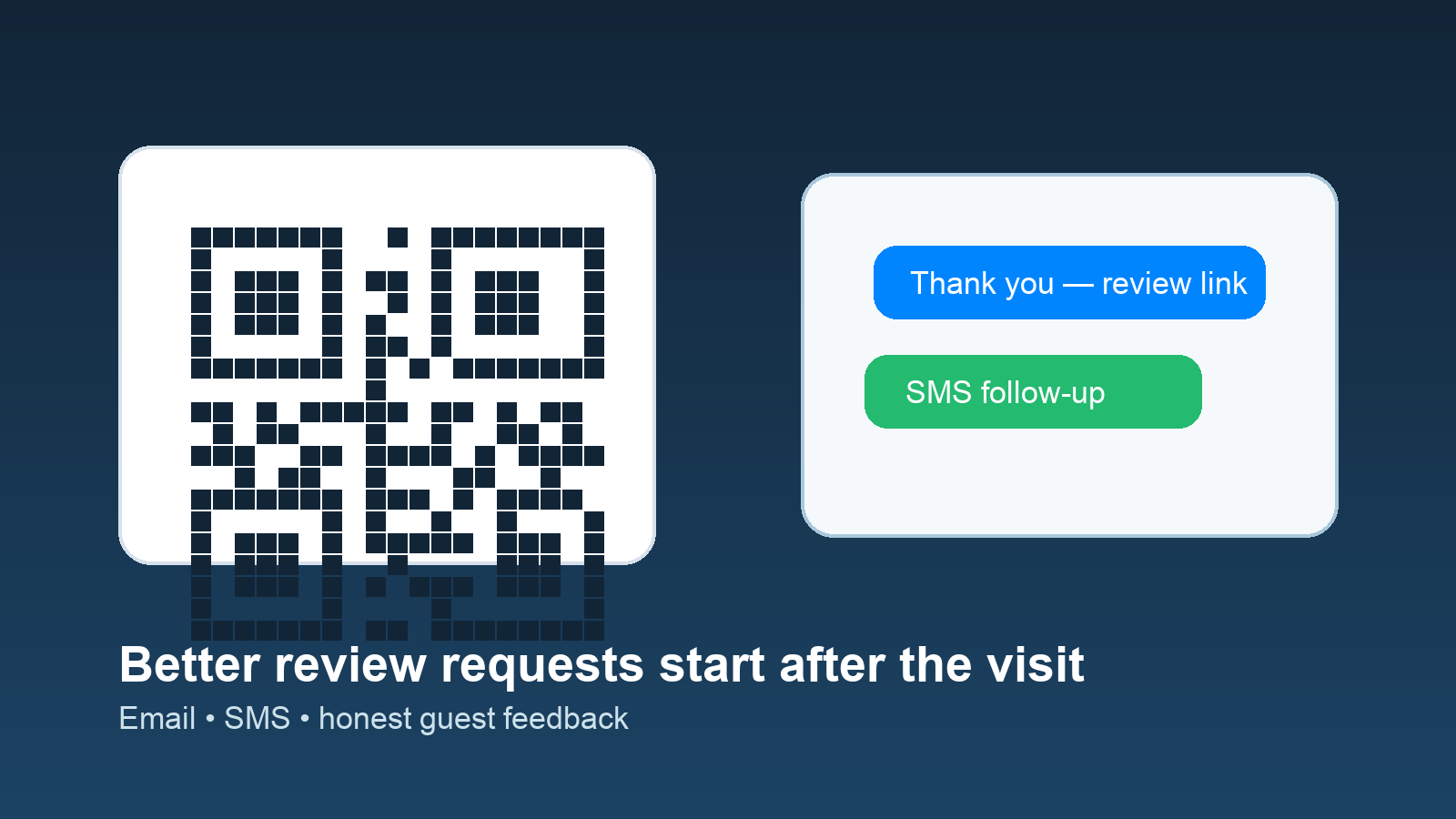
But the better long-term approach is often not a board at all. A well-timed email, SMS or WhatsApp-style follow-up after the visit can be more natural, more measurable and less likely to create the feeling that the guest is being pushed to review while still on the premises.
First, what does Google actually say?
The important point is nuance. Google does allow businesses to ask for reviews. Google Business Profile help pages explain that businesses can ask customers to visit a Google review link or scan a QR code. Google also provides a way to create a review link or QR code, and even mentions that the QR code can be printed and displayed.
So the issue is not simply “QR codes are banned”. That would be too broad.
The policy risk is around pressure, manipulation and review quality. Google’s Maps user-generated content policy says reviews should reflect a genuine experience. It prohibits incentives in exchange for reviews, discouraging negative reviews, selectively soliciting positive reviews, and requiring or pressuring users to leave ratings or write reviews while on the premises.
That means an on-site QR board can be acceptable in a neutral, low-pressure setting. But it can become risky when staff push guests to scan it immediately, when guests feel watched, when only happy guests are directed to it, or when the business tries to influence what the guest should write.
Why on-site QR review boards can be weaker than they look
QR code boards are popular because they are easy. You print once, place it at the desk, and hope the reviews come in. But convenience for the business is not always convenience for the guest.
- The timing is often wrong. A guest checking out may be thinking about luggage, transport, payment, children, or the next appointment. That is not always the best moment for a thoughtful review.
- It can feel public. If the guest is standing in reception while staff are nearby, the request may feel less voluntary, even when the business means well.
- It gives no context. A board cannot personalise the message, thank the guest properly, or remind them what made the stay or service valuable.
- It is hard to measure. You cannot easily know who scanned, who reviewed, which staff interaction led to the review, or which guest journey created the best response.
- It may encourage rushed reviews. Quick reviews are not necessarily bad, but hospitality businesses benefit from more considered feedback that mentions the room, service, food, location, cleanliness or experience.
Why email and SMS are usually better for review requests
Email and SMS work better because they move the review request into a more natural moment. The guest is back on their own device, in their own time, and away from the social pressure of the front desk.
For hospitality businesses, this matters. A review is not only a star rating. It is a public trust signal. The best reviews often come after the guest has had a moment to reflect: “The check-in was easy”, “the room was clean”, “the host gave great local advice”, “the breakfast was excellent”, or “the location was perfect for our trip”.
A follow-up message also allows the business to be more helpful and more compliant:
- It can be neutral. Ask for honest feedback, not only positive reviews.
- It can be timed properly. Send it a few hours after checkout, the next morning, or after the service has been completed.
- It can include the correct direct link. One tap should take the guest to the right Google review page.
- It can be tracked. You can measure open rates, clicks, response rates and which communication channels perform best.
- It can improve operations. If someone has a problem, your message can invite them to reply directly as well as leave public feedback, helping you fix issues rather than ignore them.
A better review request workflow for accommodation businesses
A strong review workflow does not need to be complicated. The goal is to make the request easy, respectful and consistent.
- Ask at the right time. For accommodation, the first request usually works best after checkout, not while the guest is still trying to leave.
- Use the guest’s preferred channel. Email is good for fuller messages. SMS is good for short, direct prompts. WhatsApp may be useful where guests already use it for operational communication, but privacy and consent still matter.
- Keep the wording neutral. Avoid “Please give us five stars”. Rather say, “If you have a moment, your honest review helps future guests understand what to expect.”
- Do not incentivise the review. No discounts, free upgrades, prizes or rewards in exchange for posting, changing or removing a review.
- Do not filter only happy guests. Review gating — asking only satisfied guests to post publicly while routing unhappy guests elsewhere — is a policy and trust problem.
- Respond to reviews. A calm, helpful reply shows future guests that the business is engaged and accountable.
Example wording for a compliant review request
Thank you for staying with us. If you have a minute, we would appreciate your honest feedback on Google. Your review helps future guests make informed travel decisions and helps us improve our service.
Then include the Google review link.
This wording is simple, human and neutral. It does not ask for a five-star review, does not offer a reward, and does not pressure the guest to write anything specific.
Should you remove the QR board completely?
Not necessarily. A QR code can still be useful if it is presented as an optional convenience, not as the main review engine. For example, a small “Your feedback helps us improve” card in a room or on a receipt is different from staff asking every guest to scan a code before they leave.
The better strategy is to treat QR as a secondary option and build your main review request process around post-stay communication. That gives guests more control and gives the business better data.
Key takeaways
- Google allows businesses to request reviews and provides review links and QR codes.
- The risky part is pressure, incentives, selective solicitation, or asking guests to review while still on the premises in a way that feels required.
- Email and SMS usually create a better review experience because the guest responds later, on their own device, in their own time.
- Review requests should be neutral, honest and easy to complete.
- For hospitality businesses, review generation should be part of the guest communication workflow, not just a printed board at reception.
Frequently asked questions
Are Google review QR codes allowed?
Yes, Google provides a way to create and share a review link or QR code. The issue is not the QR code itself, but how it is used. The request should be neutral, voluntary and based on a genuine customer experience.
Can I ask guests for a Google review while they are still on the property?
Be careful. Google’s policy says merchants should not require or pressure users to leave ratings or write reviews while on the premises. A passive, optional prompt is different from a staff-driven push that makes the guest feel obliged.
Is SMS better than email for review requests?
SMS is often better for quick action because it is short and immediate. Email is better when you want a warmer message with more context. Many hospitality businesses should test both and measure which channel produces the most genuine reviews.
Sources
- Google Maps User Generated Content Policy: prohibited and restricted content
- Google Business Profile Help: tips to get more reviews
- Google Business Profile Help: create a Google link or QR code to request reviews
For hotels, guest houses and local hospitality businesses, the real opportunity is not to chase reviews harder. It is to build better guest communication. When the message is timed well, worded honestly and delivered through the right channel, the review feels like a natural part of the guest relationship — not a forced transaction at the front desk.