

For many South African guest houses, lodges, B&Bs and self-catering properties, online travel agencies are both helpful and frustrating. They can bring visibility, trust and bookings — but they can also increase commission costs and make owners feel dependent on platforms they do not control.
This guide looks at some of the popular OTAs in South Africa and, more importantly, how accommodation owners can use them without losing sight of direct bookings. The goal is not to choose one winner. The better question is: which platforms fit your property, your market and your long-term booking strategy?
Key takeaways
- OTAs are useful visibility channels, not a complete marketing strategy.
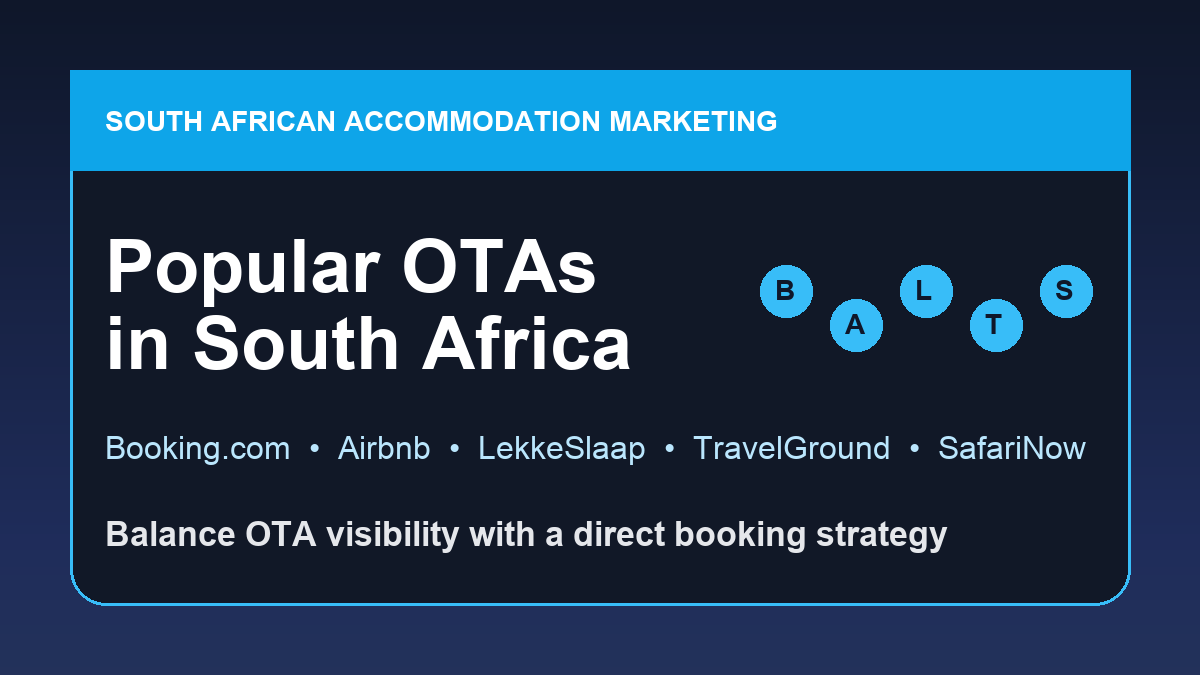
- Booking.com, Airbnb, LekkeSlaap, TravelGround and SafariNow are commonly used by South African accommodation businesses.
- International OTAs can bring reach; local OTAs can bring strong domestic traveller intent.
- The biggest risk is depending on OTAs while neglecting your own website, Google profile, guest database and direct booking process.
- A good direct booking strategy lets you benefit from OTA exposure without giving away every guest relationship.
Advertisement
What is an OTA?
An OTA, or online travel agency, is a platform where guests can search for and book accommodation. Instead of finding your website directly, the guest finds your property through a marketplace that already has traffic, filters, reviews, payment tools and booking infrastructure.
For accommodation owners, the trade-off is simple: OTAs can help you get found, but they usually charge commission and control much of the booking experience. That is why OTAs should be treated as part of your distribution mix, not as the whole business.
Popular OTAs and accommodation platforms in South Africa
The South African market is a mix of global platforms and local accommodation brands. The right mix depends on whether you run a hotel, guest house, lodge, apartment, farm stay, coastal self-catering unit or city accommodation.
- Booking.com — one of the strongest global OTAs, with major search visibility and broad accommodation coverage. It is often important for hotels, guest houses and city properties that want international and local reach.
- Airbnb — especially relevant for self-catering units, apartments, unique stays, farm stays and properties where travellers compare experience, location and lifestyle as much as room type.
- LekkeSlaap — a familiar South African accommodation brand with strong local leisure travel relevance, particularly for guest houses, lodges, B&Bs and self-catering stays.
- TravelGround — another well-known local platform used by South African travellers looking for guest houses, holiday accommodation, lodges and destination-based stays.
- SafariNow — long associated with South African accommodation discovery, including lodges, guest houses, safari stays and holiday accommodation.
- Expedia / Hotels.com — useful for international distribution and hotel-style inventory, especially where the property wants to appear in global travel searches.
- Agoda — more international in feel, but still relevant for some South African hotels and accommodation providers that want broader marketplace exposure.
- Trip.com and other global platforms — worth considering for specific markets, but usually not the first priority for every small accommodation business.
This list should not be read as a ranking. OTA performance changes by destination, season, property type, pricing, cancellation policy, review score and how well the listing is maintained.
Local OTAs vs international OTAs
International OTAs are useful because they already have large audiences, strong search visibility and trusted booking flows. If a traveller searches broadly for accommodation in Cape Town, Durban, Johannesburg, the Garden Route or Kruger areas, large platforms often appear near the top of search results.
Local South African platforms can be valuable because they understand local travel patterns. Domestic travellers often search for weekend breaks, school holiday stays, pet-friendly units, self-catering options, family rooms, fishing destinations, farm stays and affordable guest house accommodation. Local platforms may match those behaviours better than a purely hotel-focused international marketplace.
Why accommodation owners use OTAs
- Visibility: OTAs already have search traffic and brand recognition.
- Trust: Guests may feel safer booking through a platform they know.
- Reviews: Strong OTA reviews can help a property convert more easily.
- Convenience: Guests can compare price, location, photos, rules and availability in one place.
- Low starting barrier: A small property can get listed before it has a mature direct booking website.
For a new or under-marketed property, OTAs can be a useful starting point. They can help prove demand, fill quiet periods and expose the property to travellers who would not otherwise know it exists.
The risk of relying too much on OTAs
The problem starts when OTAs become the only reliable source of bookings. At that point, the business may be visible, but it is not really in control of its own demand.
- Commission pressure: Every booking has a cost, and that cost can become painful during busy periods when guests may have booked direct anyway.
- Less guest ownership: The OTA controls much of the booking relationship, communication flow and guest data.
- Policy dependency: Changes in ranking, cancellation rules, payment terms or visibility can affect your revenue quickly.
- Price comparison pressure: Guests may compare your property mainly on price rather than value.
- Operational complexity: Multiple platforms require accurate rates, availability, photos, descriptions and rules.
How to use OTAs without losing direct bookings
A healthy strategy is not “OTA or direct”. It is usually both. OTAs help travellers discover you; your own systems help you build a business that is less dependent on paying commission forever.
- Keep your own website clear and trustworthy. Guests who research your property after seeing it on an OTA should find a professional website with good photos, room information, location details and direct contact options.
- Make direct booking easy. If you want direct bookings, do not hide your phone number, WhatsApp link, enquiry form or booking engine.
- Use Google Business Profile properly. Many travellers check Google Maps, reviews and directions before booking. Your Google profile should support your direct booking path.
- Protect rate and content accuracy. Make sure your room names, policies, photos and availability do not conflict across platforms.
- Track where enquiries come from. Even simple tracking can show whether guests discovered you on an OTA but contacted you direct later.
- Build relationships after the stay. Repeat guests, referrals and past-guest communication are areas where direct bookings become powerful.
When a channel manager becomes important
If you list on several OTAs, availability management becomes more serious. A guest house with only a few rooms cannot afford double bookings, especially during peak periods. This is where a channel manager or connected reservation system can help by keeping availability and rates aligned across platforms.
Not every small property needs complex software on day one. But once you are managing multiple OTAs, direct enquiries, WhatsApp requests and repeat guests, manual updates become risky. The technology should reduce friction for the owner and make the booking decision easier for the guest.
Simple OTA decision checklist
Before adding another OTA, ask:
- Does this platform reach the type of guest I actually want?
- What commission or fees will apply?
- Can I manage availability accurately?
- Do I have enough good photos and listing content?
- Will this platform complement or compete with my direct booking strategy?
- Can I measure whether bookings from this platform are profitable?
- What happens if I become dependent on this channel?
Common mistakes South African accommodation owners make
- Listing everywhere without a system. More platforms can mean more admin, not automatically more profit.
- Using outdated photos. OTA guests compare visually. Poor photos can make a good property look average.
- Ignoring reviews. Reviews influence both OTA conversion and direct booking trust.
- Not checking mobile experience. Guests often research and book from phones. Your direct path must work well on mobile.
- Forgetting the direct booking follow-up. A guest who found you once through an OTA may book direct next time if the experience and communication are good.
Frequently asked questions
Which OTA is best for guest houses in South Africa?
There is no single best OTA for every property. Booking.com, Airbnb, LekkeSlaap, TravelGround and SafariNow can all be useful, depending on your location, accommodation type, pricing, cancellation rules and target guest.
Should a guest house use more than one OTA?
Many properties do, but only if they can manage availability properly. Listing on multiple OTAs without a channel manager or disciplined process can increase the risk of overbookings and inconsistent information.
How can accommodation owners reduce OTA dependency?
Use OTAs for visibility, but build a stronger direct booking path: a clear website, trust signals, Google Business Profile, fast enquiry replies, a booking engine where needed, and follow-up communication with past guests.
Are local South African OTAs still worth using?
Yes, local platforms can be valuable because many South African travellers recognise them and use them for leisure, self-catering, guest house and lodge searches. The key is to compare commission, exposure and booking quality.
Related reading
- Why Direct Bookings Matter for Hotels and Guest Houses
- Best Booking Engine for Guest Houses and Small Hotels
- Hotel Website SEO Guide for Guest Houses and Accommodation Owners
Final thought
OTAs are useful tools, especially in a competitive tourism market like South Africa. But they should support your accommodation business, not define it completely. The strongest position is to use OTAs for visibility while steadily improving your own website, direct booking process, guest communication and repeat-guest relationships.
Travel will always be a personal choice. Technology should simply make that choice easier — for the guest and for the accommodation owner.