

For many accommodation businesses in South Africa, NightsBridge has been one of the familiar names in online booking and channel management. It has helped guest houses, lodges, B&Bs, self-catering properties, and small hotels manage availability, connect to booking channels, accept payments, and reduce some of the manual work that used to come with reservations.
I used NightsBridge because it solved real problems at the time. It helped move accommodation operations away from handwritten booking books, manual availability updates, and constant back-and-forth with guests.
But hospitality technology is changing quickly. The reason I moved away from NightsBridge was not because it had no value. It was because my expectations of a reservation system changed. I now believe accommodation businesses need systems that are more open, more connected, more automation-friendly, and more ready for the future of AI-driven hospitality.
Key takeaways
- NightsBridge still offers useful hospitality tools, especially for channel management, direct bookings, payments, PMS links, POS integrations, guest communication, and local support.
- My concern is not whether it can manage bookings, but whether it is open enough for modern automation, analytics, APIs, AI tools, and custom workflows.
- Modern reservation systems should help accommodation businesses build connected, data-driven guest journeys instead of locking important data inside one platform.
NightsBridge still offers useful hospitality tools
To be fair, NightsBridge is not a basic system. Looking at its current public feature pages, the platform covers several important areas for accommodation providers.
- Channel management for local and international booking channels.
- A direct booking engine for property websites.
- Front-desk booking software for managing bookings, guests, invoices, reports, and availability.
- Payment tools through NightsBridge Pay.
- Point-of-sale integrations with systems such as TallOrder, Pilot, Semper, and SpaceBiz.
- PMS connector options for linking to existing front-office or property management systems.
- Xero integration for accounting exports.
- Guest communication, mobile access, training, and local support.
For many smaller properties, this may still be enough. If the main need is to manage bookings, keep OTA availability updated, take deposits, and avoid double bookings, NightsBridge can still be a practical option.
But the question for me is no longer only: Can the system manage bookings?
The better question is: Can the system connect with the future of hospitality technology?
The hospitality system of the future must be open
Modern accommodation businesses no longer run on one piece of software. A property may use different systems for bookings, payments, accounting, guest messaging, website enquiries, marketing automation, CRM, analytics, review management, and internal reporting.
The value is no longer only inside the reservation system itself. The real value is in how well that reservation system connects to everything else.
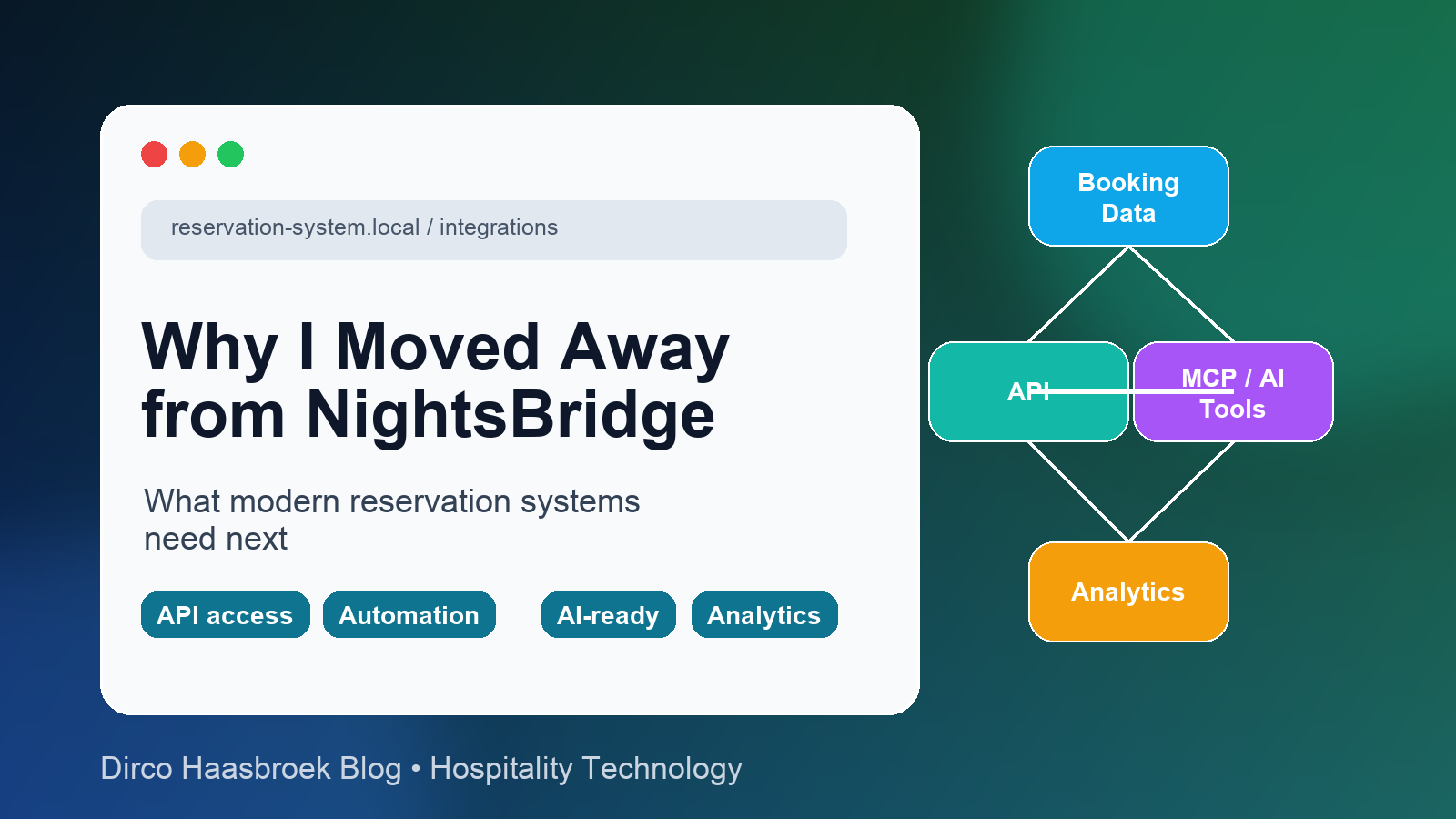
This is where APIs become important. An API allows different systems to communicate with each other. It makes it possible to build automations, custom dashboards, AI assistants, enquiry workflows, reporting tools, and integrations that match the way a business actually operates.
From what I could see on the public NightsBridge feature pages, the product has several defined integrations, but I could not find a clear public API-first or MCP-ready layer aimed at developers, automation builders, or businesses wanting to build custom workflows. That matters if your goal is to move beyond standard reservation management.
Limited integrations become a problem over time
NightsBridge does offer integrations. The Xero integration is useful, and the POS and PMS connector options are valuable for certain properties. But accounting is only one part of the business.
Accommodation owners increasingly need to connect reservation data with marketing platforms, WhatsApp automation, AI chatbots, custom websites, guest databases, loyalty systems, email campaigns, analytics tools, revenue management systems, and workflow automation tools such as n8n or Zapier-style platforms.
If a reservation system does not make this easy, the business becomes dependent on whatever features the vendor chooses to build. That can slow innovation down, especially for operators who want more control over their direct booking experience and guest communication.
Analytics need to go beyond basic reports
Analytics is another area where my expectations have changed. Most reservation systems can show occupancy, arrivals, departures, payments, and booking reports. That is useful, but modern hospitality businesses need deeper insight.
Accommodation owners should be able to answer questions such as:
- Which channels bring the most profitable guests?
- Which guests are most likely to book direct next time?
- Which enquiries are being lost before confirmation?
- Which room types convert best on mobile?
- Which marketing campaigns produce real bookings?
- Which dates need pricing adjustments?
- Which repeat guests should receive a personalised offer?
This kind of reporting requires better data access, better integrations, and better analytics design. A simple report is no longer enough. Hospitality businesses need decision-making intelligence.
AI is changing what reservation systems should do
Artificial intelligence is starting to change guest communication, booking support, search behaviour, and internal operations. In the near future, accommodation businesses will want AI assistants that can answer guest questions using real availability and property information, recommend suitable room types, help staff respond to enquiries faster, summarise guest history before arrival, identify booking trends, suggest pricing actions, and create personalised offers.
For this to work properly, reservation systems need to expose data in a secure and structured way. This is where newer concepts such as APIs and MCP become important.
MCP, or Model Context Protocol, is a newer standard that allows AI systems to connect with tools and data sources in a more structured way. In simple terms, it can help AI assistants work with real business systems instead of only answering general questions.
For hospitality, this could eventually mean an AI assistant that can safely interact with reservation calendars, guest profiles, availability data, rate plans, invoices, enquiry records, property information, and marketing workflows.
This does not mean every small accommodation system needs MCP today. But it does show where the industry is heading. The future is not only about having a booking calendar. It is about making reservation data available to intelligent tools that help the business operate better.
The problem with closed systems
Closed systems are often easier in the beginning. Everything is controlled by one provider, and the business does not have to think too much about integrations.
But over time, closed systems can become restrictive. You may want to build a better direct booking flow, but the system does not allow enough flexibility. You may want to connect guest data to your CRM, but the data is difficult to access. You may want custom analytics, but you can only use the reports provided. You may want AI-powered enquiry handling, but there is no easy way to connect live reservation data.
This is the point where the system starts shaping the business, instead of the business shaping the system. That was one of the biggest reasons I moved away.
What I now look for in a reservation system
Today, I look at reservation technology differently. For me, a modern reservation system should offer:
- Reliable channel management and real-time availability.
- A strong direct booking engine.
- Secure payment processing.
- Open API access and clear developer documentation.
- Webhook support for real-time automation.
- Flexible integrations with accounting, marketing, CRM, messaging, and analytics tools.
- Exportable data and strong reporting.
- AI-readiness and a roadmap for modern automation.
The system should not only help manage bookings. It should help build a smarter accommodation business.
This is not only about NightsBridge
This article is not only about NightsBridge. Many hospitality systems have the same problem. They were built for a previous stage of the internet.
That stage was about getting accommodation businesses online, connecting them to OTAs, and replacing manual booking books. The next stage is different. It is about connected data, automation, direct booking control, AI assistants, personalised guest journeys, and smarter business intelligence.
Reservation systems need to evolve from operational tools into connected hospitality platforms.
A fair view of NightsBridge
NightsBridge still has strengths. It understands the South African and African accommodation market. It connects to many booking channels. It provides front-desk tools, payment options, support, PMS links, POS integrations, and Xero integration. For many properties, that may still be enough.
But for businesses that want advanced automation, deeper analytics, custom guest journeys, AI-powered workflows, and flexible integrations, the system may feel limiting. That was my experience.
I did not move away from NightsBridge because it was useless. I moved away because my needs moved beyond what I felt the platform was built to support.
Hospitality technology must serve the guest and the business
At the end of the day, reservation systems are not only about software. They are about making the booking experience easier for guests and making operations easier for accommodation providers.
Travel will always be a personal choice. Technology should not remove the human side of hospitality. It should reduce friction, improve trust, and give both guests and property owners better information at the right time.
The future belongs to reservation systems that are open, connected, intelligent, and flexible. That is the kind of system I believe accommodation businesses should be looking for now.
Frequently asked questions
Is NightsBridge still useful for accommodation businesses?
Yes. NightsBridge still offers useful tools such as channel management, a direct booking engine, front-desk booking features, payments, PMS connectors, POS integrations, guest communication, mobile access, support, and Xero integration. The question is whether it is flexible enough for a business that wants deeper automation and open integrations.
Why do APIs matter in reservation systems?
APIs allow reservation data to connect securely with websites, CRMs, analytics dashboards, guest messaging tools, accounting systems, and workflow automation platforms. Without good API access, accommodation businesses can become limited by what the vendor chooses to build.
What should accommodation owners look for in modern reservation software?
Look for reliable channel management, direct booking support, secure payments, clean reporting, open integration options, webhooks, exportable data, good documentation, and a roadmap that supports automation and AI-assisted hospitality operations.