

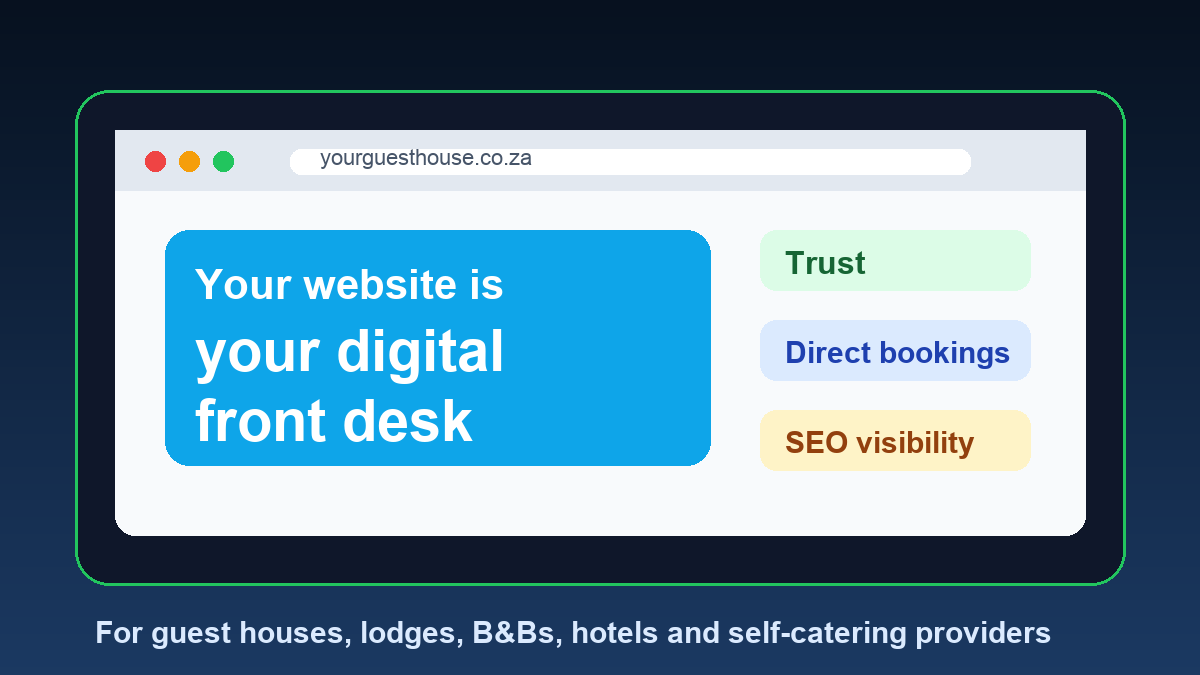
For accommodation providers, a website is more than an online brochure. It is often the place where a guest confirms whether your property feels real, trustworthy and suitable for their trip. A traveller may discover you on Google, Booking.com, LekkeSlaap, Airbnb, social media or through a recommendation — but before they commit, many still look for your own website.
That website becomes your digital front desk. It explains who you are, what you offer, where you are, how to book, and why a guest should feel comfortable choosing you. For guest houses, lodges, B&Bs, boutique hotels and self-catering providers, this matters because travel will always be a personal choice. Technology should simply make that choice easier.
Key takeaways
- A website gives accommodation providers a trusted online home that they control.
- Guests often use your website to verify photos, location, room details, policies and contact options before booking.
- A good website supports direct bookings and reduces complete dependence on OTAs.
- Your website improves local SEO, Google visibility and long-term marketing value.
- Even a simple website is valuable when it is clear, mobile-friendly and easy to use.
Advertisement
Your website is the place you control
OTAs, social media pages and Google profiles are useful, but they are not fully yours. Their layouts, ranking rules, commission structures, review displays and contact options can change. Your website is the one digital space where you can present your accommodation properly and guide the guest experience on your own terms.
This does not mean every property needs a complicated website. It means every serious accommodation provider should have a clear, reliable place where guests can find accurate information directly from the business.
A website builds trust before the guest contacts you
Accommodation is personal. Guests want to know where they will sleep, how safe the location feels, what the rooms look like, how close you are to attractions, whether parking is available, what the cancellation policy is, and whether the property looks professionally managed.
A clear website helps answer those questions before the guest phones, messages or books. It also reduces uncertainty. When your website is outdated, slow, confusing or missing key information, guests may assume the property is less organised than it really is.
It supports direct bookings
Direct bookings matter because they give accommodation providers more control over the guest relationship. When a guest books directly, you can communicate more clearly, answer questions faster, build repeat business and avoid unnecessary commission where appropriate.
A website makes direct bookings easier by giving guests a direct path: call, WhatsApp, enquiry form, email or booking engine. The right option depends on your property, but the principle is the same — guests should not have to hunt for a way to book with you.
It helps guests compare you properly
On an OTA, properties are often compared side by side by price, review score, filters and photos. Your website gives you more room to explain the full value of your accommodation: your location, hospitality style, room differences, local knowledge, breakfast, views, family-friendly features, business travel convenience or unique experiences.
This is especially important for guest houses, lodges and self-catering stays where the experience cannot always be reduced to a room rate.
It improves local SEO and Google visibility
Guests search in very specific ways: “guest house near hospital”, “self-catering accommodation in Stellenbosch”, “family accommodation near Kruger”, “B&B with secure parking”, or “lodge near wedding venue”. A website gives you pages and content that can match those searches.
Your Google Business Profile is important, but it works better when it connects to a useful website. Search engines need clear information about your location, accommodation type, amenities, nearby landmarks and booking options. A website gives you space to provide that information properly.
It reduces repetitive guest questions
Many accommodation teams spend hours answering the same questions: check-in times, parking, Wi-Fi, pet policies, breakfast, distance from attractions, group bookings, payment options and cancellation rules. A good website does not remove personal service, but it reduces unnecessary back-and-forth.
This is where technology should help hospitality, not replace it. The website handles the basic information clearly so the owner or team can focus on the parts of hospitality that need a human response.
It protects your business from platform dependency
OTAs can bring valuable bookings, but depending on them completely is risky. Commission costs, ranking changes, cancellation policy changes and platform rules can all affect your business. Social media reach can also change without warning.
Your website is part of a healthier long-term strategy. It gives returning guests, referral guests and Google searchers a direct way to find and contact you. Even if OTAs remain part of your marketing mix, your website helps keep your business from being invisible outside those platforms.
What an accommodation website should include
- Clear room or unit information: Show what guests are actually booking, including occupancy, beds, bathrooms and key amenities.
- Good photos: Use honest, bright and current images of rooms, bathrooms, common areas, views and exterior spaces.
- Location details: Explain nearby landmarks, attractions, hospitals, airports, business areas or wedding venues where relevant.
- Direct contact options: Make phone, WhatsApp, email, enquiry forms or booking buttons easy to find.
- Trust signals: Include reviews, awards, years in business, secure payment notes, policies and professional branding.
- Mobile-friendly pages: Many guests research accommodation on their phones. The site must be fast and easy to use.
- Basic SEO structure: Use clear page titles, headings, location terms and useful content that matches real guest searches.
Common mistakes to avoid
- Using only a Facebook page. Social media is useful, but it is not a replacement for a proper website.
- Hiding contact details. If guests cannot quickly phone, WhatsApp or enquire, they may move on.
- Publishing thin room pages. A photo and price are not enough for many guests to make a confident decision.
- Ignoring speed and mobile layout. A slow website can lose guests before they even see your rooms.
- Forgetting updates. Old photos, outdated policies and wrong rates damage trust.
A practical way to think about it
Your website does not need to do everything at once. Start with the essentials: accurate room information, strong photos, clear location content, simple direct enquiry options and trust-building details. Then improve over time with better SEO pages, booking engine integration, analytics, structured data and automated guest communication.
The best accommodation websites are not necessarily the flashiest. They are the ones that help guests make a confident decision and help owners reduce friction in the booking process.
Frequently asked questions
Why is a website important for accommodation providers?
A website gives accommodation providers a trusted home online where guests can see rooms, location, policies, photos, contact details and booking options without relying only on OTAs or social media.
Can a guest house rely only on OTAs?
OTAs can be useful for visibility, but relying only on them means the business has less control over commission costs, guest data, brand presentation and repeat booking relationships.
Does a small B&B still need a website?
Yes. Even a small B&B benefits from a simple, clear website because guests often check Google, photos, location and direct contact options before deciding where to stay.
What should an accommodation website include?
At minimum it should include good photos, room or unit information, location details, contact options, direct booking or enquiry options, reviews or trust signals, policies and mobile-friendly pages.
Related reading
- Why Direct Bookings Matter for Hotels and Guest Houses
- Hotel Website SEO Guide for Guest Houses and Accommodation Owners
- Best Booking Engine for Guest Houses and Small Hotels
- Popular OTAs in South Africa: A Practical Guide for Guest Houses and Small Hotels
Final thought
A website is important for accommodation providers because it gives the business control, credibility and a direct path to the guest. OTAs, Google and social media can all help guests discover you, but your website is where you can tell your story clearly and guide the booking decision.
For guest houses, lodges, B&Bs and self-catering providers, that clarity matters. Guests are not only buying a bed for the night — they are choosing where they will feel comfortable spending part of their journey.



[…] Why a Website Is Important for Accommodation Providers […]
[…] Why a Website Is Important for Accommodation Providers […]